
Why Cars Stopped Looking Cool in the 70's

Updated: Feb 4, 2023
If you're like me. You've drooled over the musclecars of the 60's and early 70's but then noticed something significant changed midway through the 70's that just doesn't look right. They seem chunkier, broader, boxier and in some cases just downright uglier. This is the story of why.

1967 Mustang
In a nutshell, automakers were forced to adapt existing designs to new demands. Much like how the newly required and strictly mandated emissions standards would choke down these once great automobiles to become shells of their former selves, so too were the shells themselves a bulked up ugly mass of their former glory. Most of them just feel disjointed and perhaps that's because the designs were done by force and not by choice. In a pinch, necessity trumped imagination.
Simply put, follow the money. It all begins in 1966 when the National Highway Traffic Safety Administration (NHTSA) was created. Through the 1960's the bean counters at all of the insurance companies started to notice they were paying out exorbitantly large sums of money on fender benders under 5 MPH. The creation of this new agency gave them an opening they just simply couldn't refuse. It led to a lobbying campaign that successfully forced the NHTSA to implement a new bumper standard with the Federal Motor Vehicle Safety Standard (FMVSS) 215. This new standard was issued on April 9, 1971 and required that all new vehicles sold in the united states be able to take a 5 MPH impact from the front and 2.5 MPH from the rear with no damage to certain safety related components such as Headlights and fuel systems which took affect on September 1, 1972. Just in time for the 1973 model year.

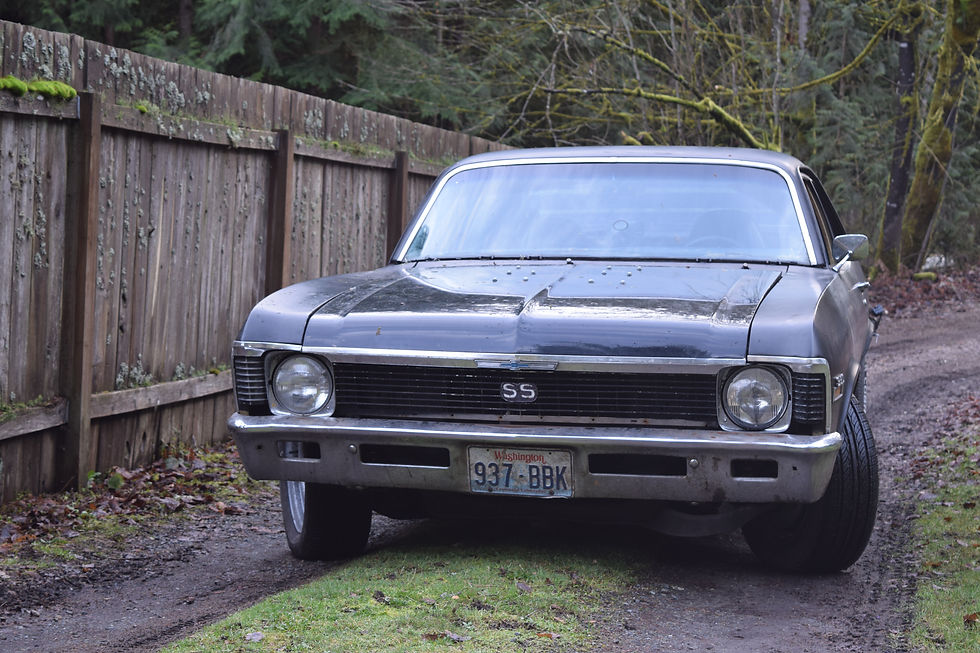
Top: 1972 Nova - Bottom: 1973 Nova

Clearly the incredibly pleasing eye candy of split bumpers was no longer going to cut it. You may also notice that many designs up to this point had a rearward sweeping grill design from the tip of the hood down to the base of the bumper such as seen on the 1972 Nova. Not so on the 1973 Nova, now you get a much flatter grill and a bumper that hangs way out in front. After all, if the hood sticks out as far as the bumper then the bumper doesn't do much good does it? Notice the "afterthought" fill caps in the front corners of the fenders? The turn signals are also relocated from the bumper to the grill. This same trend is seen over and over across all of the major suppliers beginning with the 1973 model year. The European imports are even worse, as if they wanted Americans to quit buying their cars just for the inconvenience of forcing them to change the design. This was the beginning of a long, arduous road where American cars for more than the next decade would no longer be designed for fun and sport, but for survival... And only a few would survive.
The most comical part of this, perhaps only for those of us with a sick sense of humor, is that the insurance companies quest to save a few bucks actually ended up with more people getting injured. You see, just because the car doesn't take any damage doesn't mean the people don't. In fact quite the opposite. Within a month of the 1973 model year being produced it was recognized by congress that the sudden stop of a 5 MPH impact would send more of the impact's energy into the people rather than the car itself absorbing it.

1971 "Split-Bumper" Camaro
This led to the passage of the Motor Vehicle Information and Cost Saving Act of October 1972 which mandated that the NHTSA issue a bumper standard that yields the maximum feasible reduction of costs to the public, taking into account the cost and benefits of implementation, the standard’s effect on insurance costs and legal fees, savings in consumer time and inconvenience, and health and safety considerations. Clearly Congress felt the insurance companies had kind of gotten away with one so to speak and that there was much more at stake than just vehicle damage.
Over the years this legislation would get ironed out a little. In 1976 the bumper code would all be consolidated into 49 CFR Part 581 which would include a "no damage" requirement for 5 MPH impacts for passenger cars beginning in 1980 finally settling in with the most recent revision in 1982 under the Reagan administration which reduced test impact speeds from 5 mph to 2.5 mph for longitudinal front and rear barrier and pendulum impacts and from 3 mph to 1.5 mph for corner pendulum impacts.

1977 Pontiac Firebird
Over the years automakers would develop new designs to pave the way for a new era of automotive aesthetics. This is where we see the aero designs beginning in the late 1970's with cars like the Camaro and Firebird. With a sharp point beginning at the front bumper and flowing rearward from there to reveal the rest of the body. While these designs did come out pretty cool, they were mostly intended to protect the rest of the car from a bumper impact. It's a design that's lasted to this day in most American sports cars. We can even trace the design of todays faceless blobs back to the roots of this 1970's legislation. They've certainly come a long way since the early days of the mid 70's when Detroit was forced out of necessity to adapt previous designs to new requirements. Cars like the new Mustang, Challengar, and Camaro have managed to capture some of that old flavor combined with new looks, but one thing is certain... The true old school looks of swept back grills and split bumpers is history.



Comments